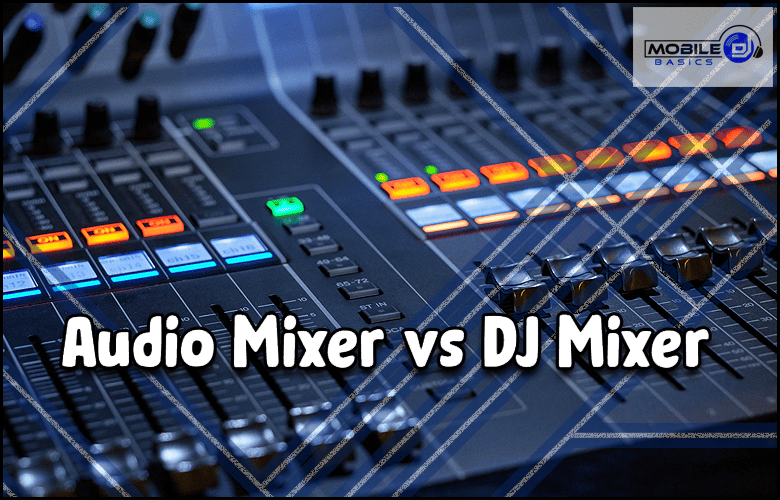
Audio Mixer Vs DJ Mixer differences can make or break your setup choice, whether you’re spinning tracks at a wedding or recording a podcast. These two types of mixers serve different purposes and offer distinct features that cater to specific audio needs.
Understanding which mixer fits your goals will save you money and frustration down the road. Let’s break down the key differences so you can make an informed decision.
TL;DR
- DJ mixers have built-in crossfaders and cue systems, while audio mixers focus on multi-channel recording and live sound reinforcement.
- Audio mixers typically offer 8-32 channels compared to DJ mixers’ 2-4 channels, making them better for band recordings.
- DJ mixers include tempo sync and loop controls specifically designed for beatmatching and transitions.
- Audio mixers provide phantom power for condenser microphones, while most DJ mixers do not.
Audio Mixer Vs DJ Mixer: Core Design Differences
The fundamental difference lies in their intended use cases and workflow design. DJ mixers are built for seamless music transitions and live performance, while audio mixers handle complex recording sessions and live sound reinforcement.
DJ mixers prioritize quick access to essential controls during live sets. You’ll find large crossfaders, dedicated cue buttons, and tempo controls prominently placed for instant access while performing.
Channel Count and Layout
Audio mixers typically feature 8 to 32 channels, allowing you to connect multiple microphones, instruments, and line sources simultaneously. This makes them perfect for recording bands or managing live events with many audio sources.
DJ mixers usually offer 2 to 4 channels, which is enough for most DJing scenarios. Each channel is optimized for music sources like turntables, DJ controllers, or media players.
Control Features and Functions
The control layout reveals each mixer’s priorities and strengths. DJ mixers excel at music manipulation, while audio mixers focus on signal processing and routing.
DJ Mixer Controls
- Crossfader – enables smooth transitions between two audio sources.
- Cue System – lets you preview tracks through headphones before mixing them in.
- EQ Controls – typically 3-band EQ (high, mid, low) with kill switches for dramatic effects.
- Tempo Controls – pitch faders and sync buttons for beatmatching.
- Loop Controls – built-in loop functions for extending track sections.
Audio Mixer Controls
- Gain Control – precise input level adjustment for each channel.
- Phantom Power – 48V power for condenser microphones.
- Auxiliary Sends – multiple send paths for effects processing and monitor feeds.
- Insert Points – direct access to signal path for external processing.
- Comprehensive EQ – often 4-band with sweepable mid frequencies.
Quick Identification Tip
Look for a crossfader – if it’s there, you’re looking at a DJ mixer. Audio mixers use channel faders only.
Audio Quality and Signal Processing
Both mixer types deliver professional audio quality, but they optimize for different scenarios. Audio mixers typically offer more detailed signal processing options and routing flexibility.
DJ mixers focus on maintaining consistent levels and providing tools for creative mixing. They often include built-in effects like reverb, delay, and filters that work well with music performance.
Input and Output Options
Audio mixers provide diverse connectivity options including XLR, 1/4″ TRS, and RCA inputs to accommodate various audio sources. You’ll also find multiple output options for recording, monitoring, and sound reinforcement.
DJ mixers concentrate on music-specific connections like phono inputs for turntables, line inputs for media players, and headphone outputs with independent cueing. Most modern units also include USB connectivity for laptop DJing.
Price Ranges and Value Considerations
Entry-level audio mixers start around $100-200 for basic 8-channel models, while professional versions can cost $2,000-5,000 depending on features and channel count. The investment pays off for recording studios and live sound applications.
DJ mixers range from $150 for basic 2-channel units to $3,000+ for high-end models with advanced effects and connectivity. Professional DJ mixers often include club-standard features and build quality.
Choosing the Right Mixer for Your Needs
Your primary use case determines which mixer type serves you better. Consider where and how you’ll use the mixer most often.
Choose a DJ Mixer If You
- Play music at events – weddings, parties, clubs, or mobile DJ gigs.
- Mix tracks live – beatmatching, transitions, and creative mixing.
- Use turntables – need proper phono preamps and pitch control.
- Want portability – compact size for mobile setups.
Choose an Audio Mixer If You
- Record multiple instruments – bands, podcasts, or studio work.
- Run live sound – venues, conferences, or performance spaces.
- Need many inputs – multiple microphones and instruments simultaneously.
- Want routing flexibility – complex signal path requirements.
Integration with DJ Equipment
DJ mixers integrate seamlessly with other DJ gear like turntables, controllers, and media players. They’re designed to work as the central hub of a DJ setup.
Audio mixers can work in DJ applications but lack specialized features like crossfading and cue systems that make live mixing smooth and intuitive. You’ll spend more time managing controls instead of focusing on the music.
Articles You May Like
Frequently Asked Questions
Can I use an audio mixer for DJing?
Yes, but you’ll miss key features like crossfaders, cue systems, and tempo controls that make DJ mixing smooth and intuitive.
Do DJ mixers work for recording music?
Basic recording is possible, but DJ mixers lack the multiple inputs, phantom power, and routing options needed for professional recording sessions.
Which mixer type offers better sound quality?
Both offer professional audio quality, but audio mixers typically provide more detailed signal processing and cleaner preamps for recording applications.
Are DJ mixers more expensive than audio mixers?
Prices overlap significantly – entry-level models in both categories start around $100-200, while professional units can cost $2,000-5,000 regardless of type.
Final Thoughts
Audio Mixer Vs DJ Mixer comes down to matching the tool to your specific needs and workflow. DJ mixers excel at live music performance with features designed for seamless mixing, while audio mixers handle complex recording and live sound scenarios.
Consider your primary use case first, then look at specific features and connectivity options that support your goals.
Subscribe to Our Newsletter

From discovering new songs to getting more gigs, I’m excited to share the wealth of knowledge I’ve gained through many years of DJing. [email protected]